Technology
Create a more representative in vitro model to increase research and development success
Nortis’ versatile microfluidic technology enables researchers to engineer a wide range of three-dimensional tissue microenvironments.
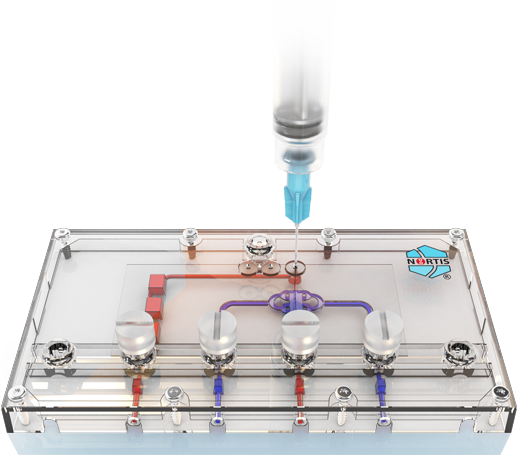
Microfluidic chips and supporting perfusion platform
About the size of a credit card, Nortis’ unique microfluidic chips can be used to grow tissue microenvironments by seeding cells into tubular voids within extracellular matrix gels. The chip design offers the flexibility to generate a variety of tissue architectures based on cell types and matrix materials selected.
Small, portable perfusion platforms house the disposable chips and supporting media and collection reservoirs. Three-shelved docking stations that reside in a standard tissue culture incubator increase experimental throughput and flexibility by enabling up to twelve independent experiments to be run at a time. Perfusion through both the tissue lumen and surrounding extralumenal space allow physico-chemical gradients to be created and perfusion fluids and cells to be collected for downstream analysis. Each docking station shelf can easily be removed and the small perfusion platform/chip assemblies accommodate easy transport between the cell culture incubator, laminar flow hood, and microscope stage.
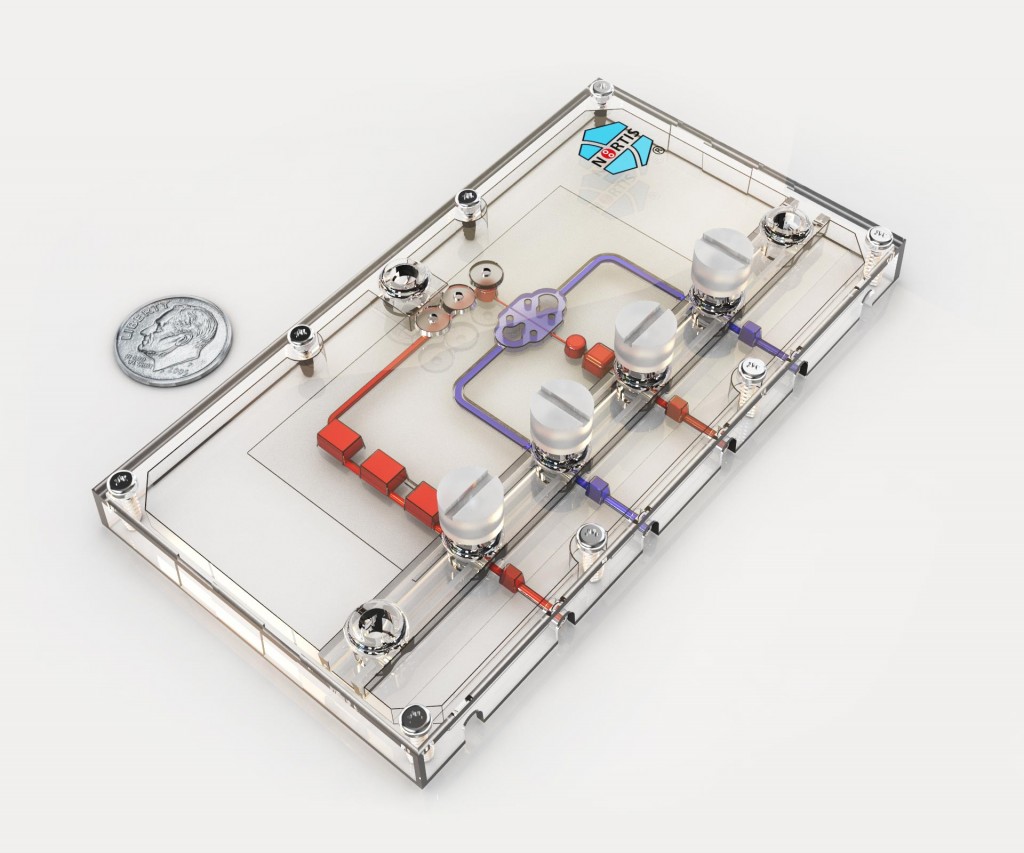
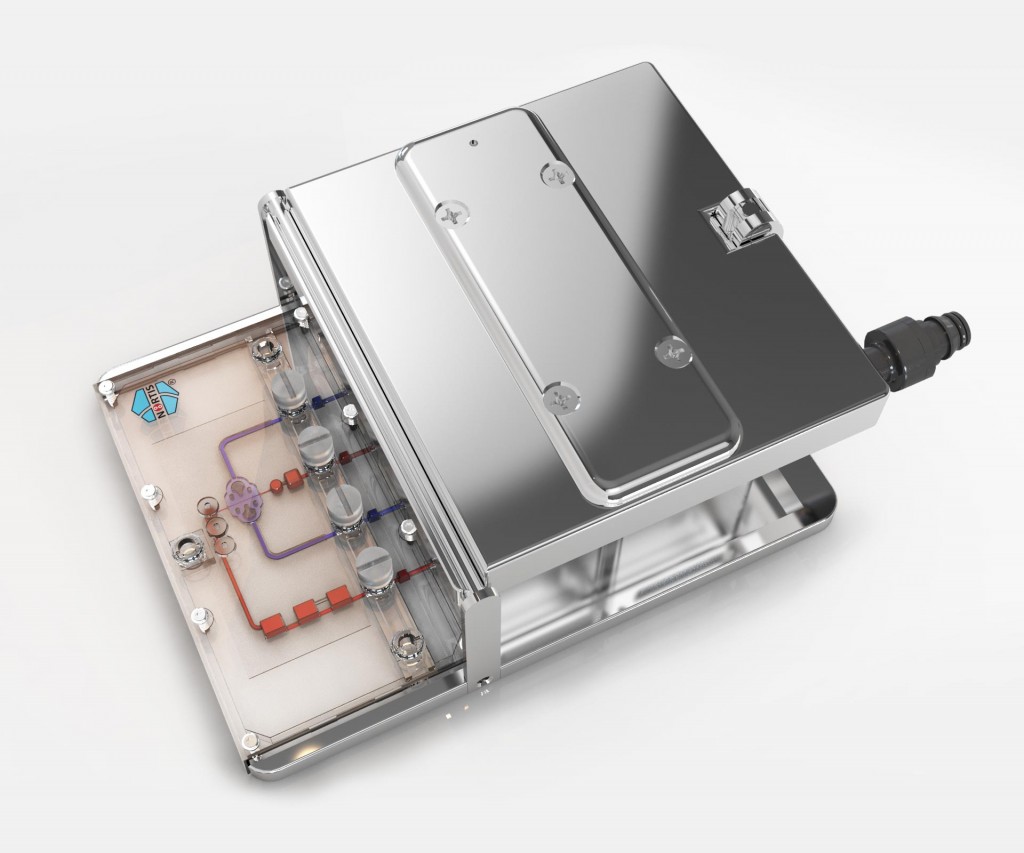
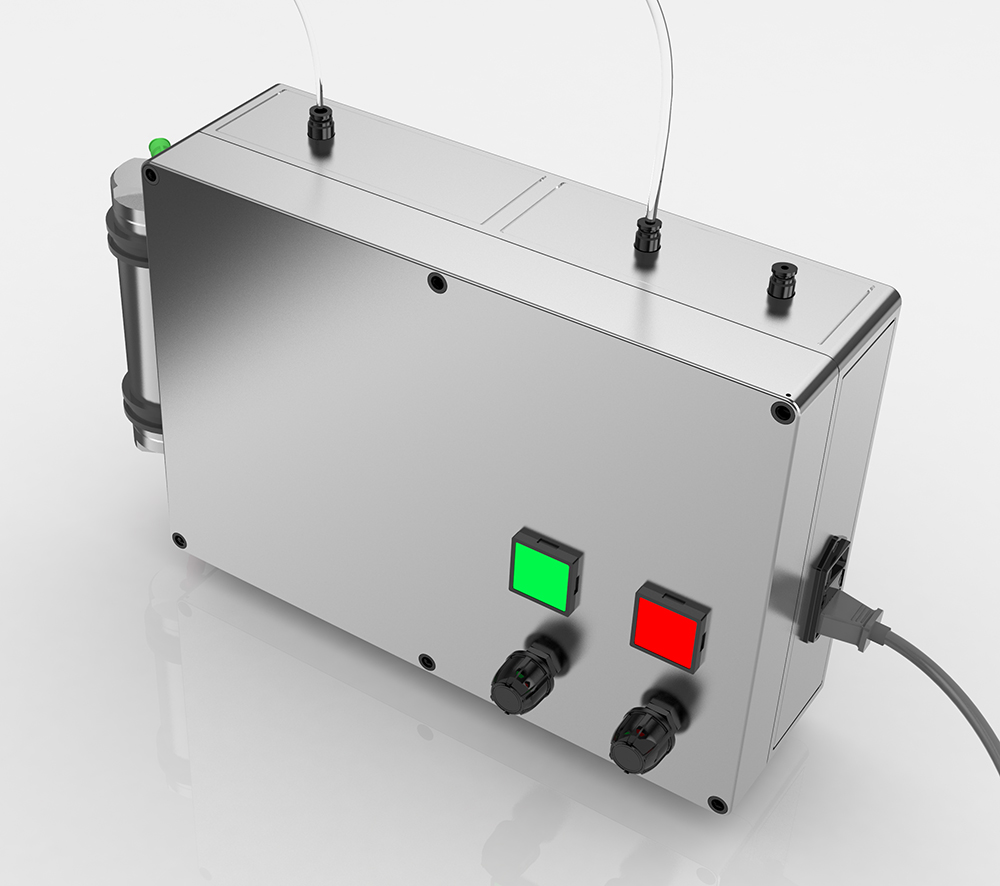
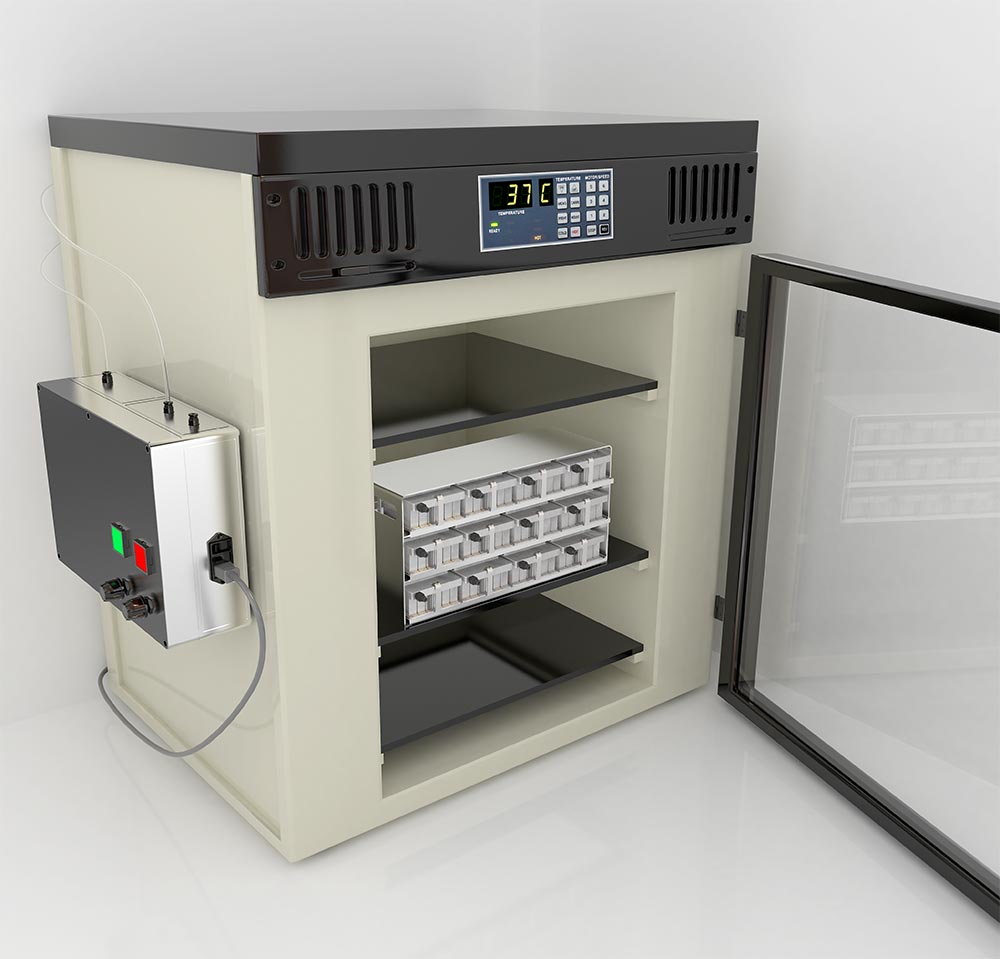
The entire Nortis system fits inside a standard tissue culture incubator.
Precise control of fluidic flow
A key element of Nortis’ technology is the ability to subject the tissues to fluid flow directly through the vessel lumen, which enables:
- Creation of vasculature and other tubular tissues
- Delivery of test compounds via the perfusate
- Exposure to shear and flow forces that are present in the body
- Independent perfusion through the vessel and matrix compartments
Applications
Confocal microscopy of a microvessel grown from human endothelial cells in a Nortis chip. The cell boundaries are labeled in green, the nuclei in blue. The red label is associated with laminin, indicating that the cells are depositing a basement membrane around the vessel.
Simulate the human tissue microenvironment
Nortis provides an efficient, affordable alternative to animal testing that can accelerate research and advance scientific exploration. By supporting fluid flow, 3D tissue culture, and robust analysis in one scalable, user-friendly platform, Nortis offers a flexible approach to drive human health research and drug development.
Nortis innovation makes it easy to:
- Engineer a variety of 3D tissue microenvironments
- Expose engineered tissues to flow and shear force via fluidic perfusion
- Perform real-time visualization under variable conditions
- Research human disease without relying on interspecies extrapolation
Innovation
Small, disposable chips and perfusion hardware enable creation of various human tissue microenvironments for relevant insight into the world’s most challenging biological questions. These tools are designed to serve a variety of applications, including:
Vascular Biology
Engineer, perfuse, and observe living human microvasculature
Organ-on-Chip
Reproduce functional units of specific organs
About Nortis
Nortis is a biotech company with locations in Seattle and Woodinville, WA. Founded by former UW faculty and spun-out in 2011, Nortis has developed technologies for generating small segments of human tissues and organs in microfluidic chips for the in vitro study of human health and disease.
The technology represents an important alternative to lab animals in pharmaceutical drug development, where more predictive preclinical test models are urgently needed to increase clinical trial success. This advance will overcome a large barrier to developing therapeutic drugs and vaccines for diseases like cancer, diabetes, Alzheimer’s disease, infectious diseases, cardiovascular disease, and stroke.
Nortis is collaborating with multiple investigators throughout the United States to prepare its core technology for commercial launch in Q3 of 2015.
Our Mission
Nortis is dedicated to developing a new generation of in vitro systems that advance the discovery of novel therapies and reduce the timeline and costs associated with their translation into the clinic.
Latest News
September, 2015 -Come visit the Nortis booth at 2015 4th TERMIS World Congress on September 8th – 11th in Boston, MA, and learn more about our commercial product.
June, 2015 -Come visit the Nortis booth at the Life Science Innovation Northwest on June 30 – July 1st in Seattle, WA, and listen to a presentation by our CEO, Thomas Neumann, to learn more about our company and upcoming commercial product.
June, 2015 -Come visit the Nortis booth at the World Pharma Congress on June 10 – 12th in Boston, MA, and learn more about our upcoming commercial product.
June, 2015 -Read about how the University of Pittsburgh and the University of Washington are developing organs-on-a-chip using the Nortis technology in Discover magazine’s latest edition.
- View Archive
Contact
Email: info@nortisbio.com
Phone: 425-406-6214
Headquarters:
Nortis, Inc.
1616 Eastlake Ave E, Suite 270
Seattle, WA 98102, USA
Manufacturing Site:
Nortis, Inc.
17280 Woodinville-Redmond Rd NE/Suite B828
Woodinville, WA 98072, USA